Beijing Brain-Computer Interface Conference Concludes: 15 Landmark Results, and the Next Mile Toward Industrialization

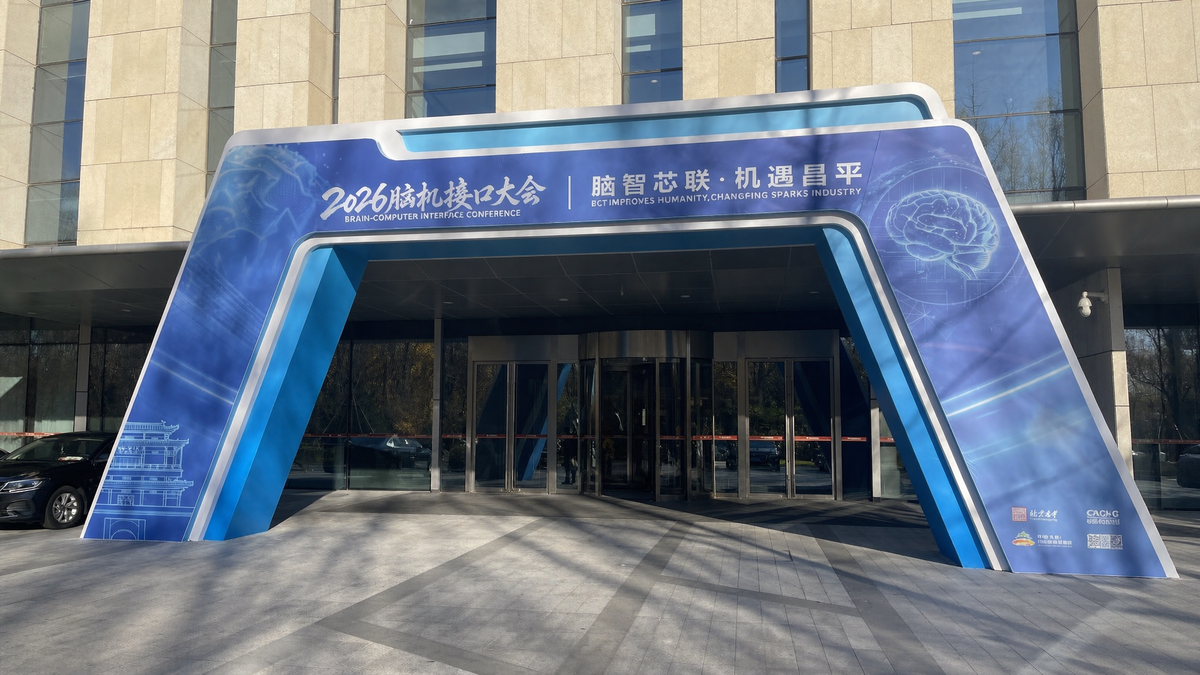
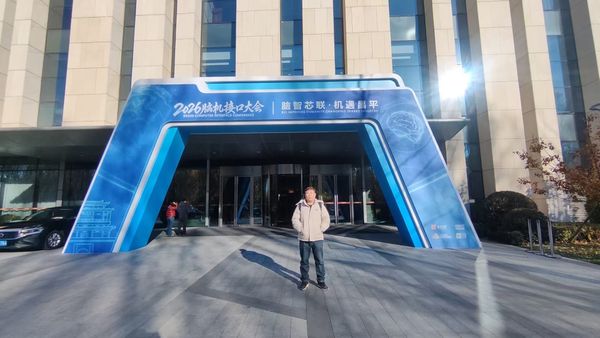
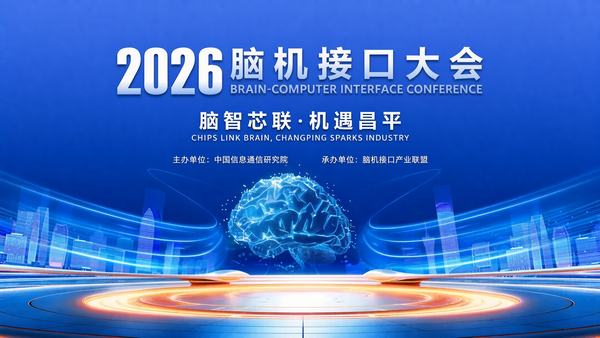
On the morning of November 21, the main forum of the 2026 Brain-Computer Interface Conference was held at Future Science City in Changping, Beijing. Ao Li, Deputy Director-General of the China Academy of Information and Communications Technology (CAICT), released the Report on the Innovative Development of Brain-Computer Interfaces (2026) on site and unveiled the “15 Landmark Results of Brain-Computer Interfaces in 2026.” The list spans core chips, implantable systems, non-invasive devices, neuromodulation, medical rehabilitation, and applied scenarios in power grid safety, transportation, and industrial security. It reads as a concentrated checkpoint of where China’s BCI field stood, in 2026, between laboratory prototypes and shippable products. The items below follow the official announcement order.
- Beinao-1 Intelligent Brain-Computer Interface System
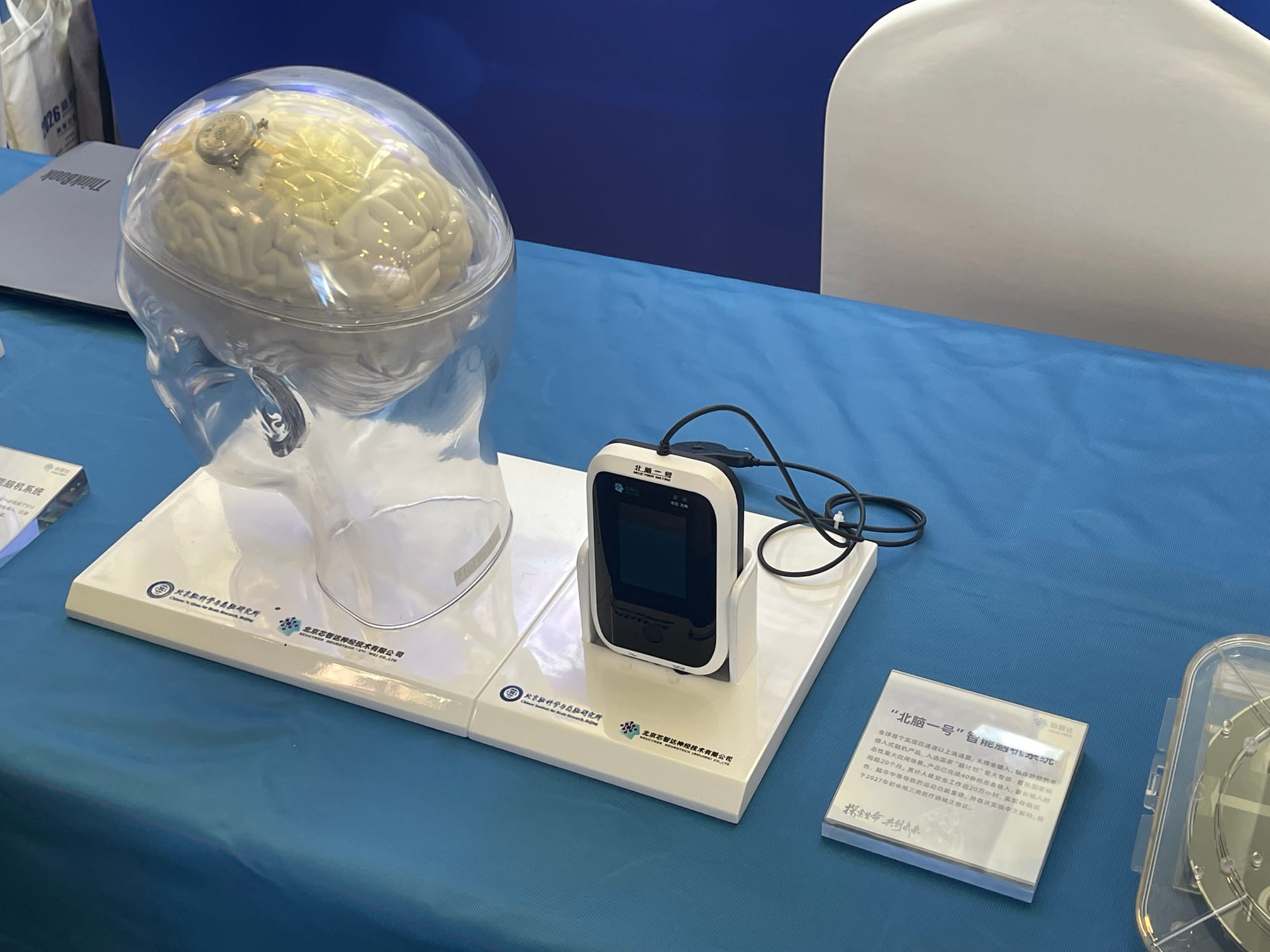
NeuCyber was established with funding from the Beijing Municipal Government and ZGC Development Group, and led by the Chinese Institute for Brain Research, Beijing (CIBR). It is the implementing entity of Beijing’s “Intelligent Brain-Computer Interface Enhancement Program,” running a translational model of “institute solves the science, company drives the clinic,” with both semi-invasive and invasive product lines in parallel.
The semi-invasive line, Beinao-1, entered the clinic first. It routes through the epidural space without touching brain tissue, uses micron-thickness high-density flexible cortical electrodes, and is a 128-channel fully implantable wireless system with wireless charging and no transcutaneous leads. It has completed 44 human implants, with the longest implantation exceeding 20 months and cumulative safe operating time in humans surpassing 170,000 hours; enrollment for the registration clinical trial is complete, and a Class III medical device registration application is planned for 2027.
The epidural path avoids direct cortical contact, so its safety case is structurally easier to argue than a fully intracortical route. With registration enrollment closed, what remains is regulatory review and follow-up data lock. Beinao-2, the 512-channel invasive successor, is scheduled to enter investigator-initiated clinical verification by year-end — that is the real test of the invasive ceiling. The variables worth watching are not the case count, but impedance drift and Mandarin decoding decay across two-year-plus in-body durations.
- Non-Invasive High-Precision EEG Acquisition and Computing Chip
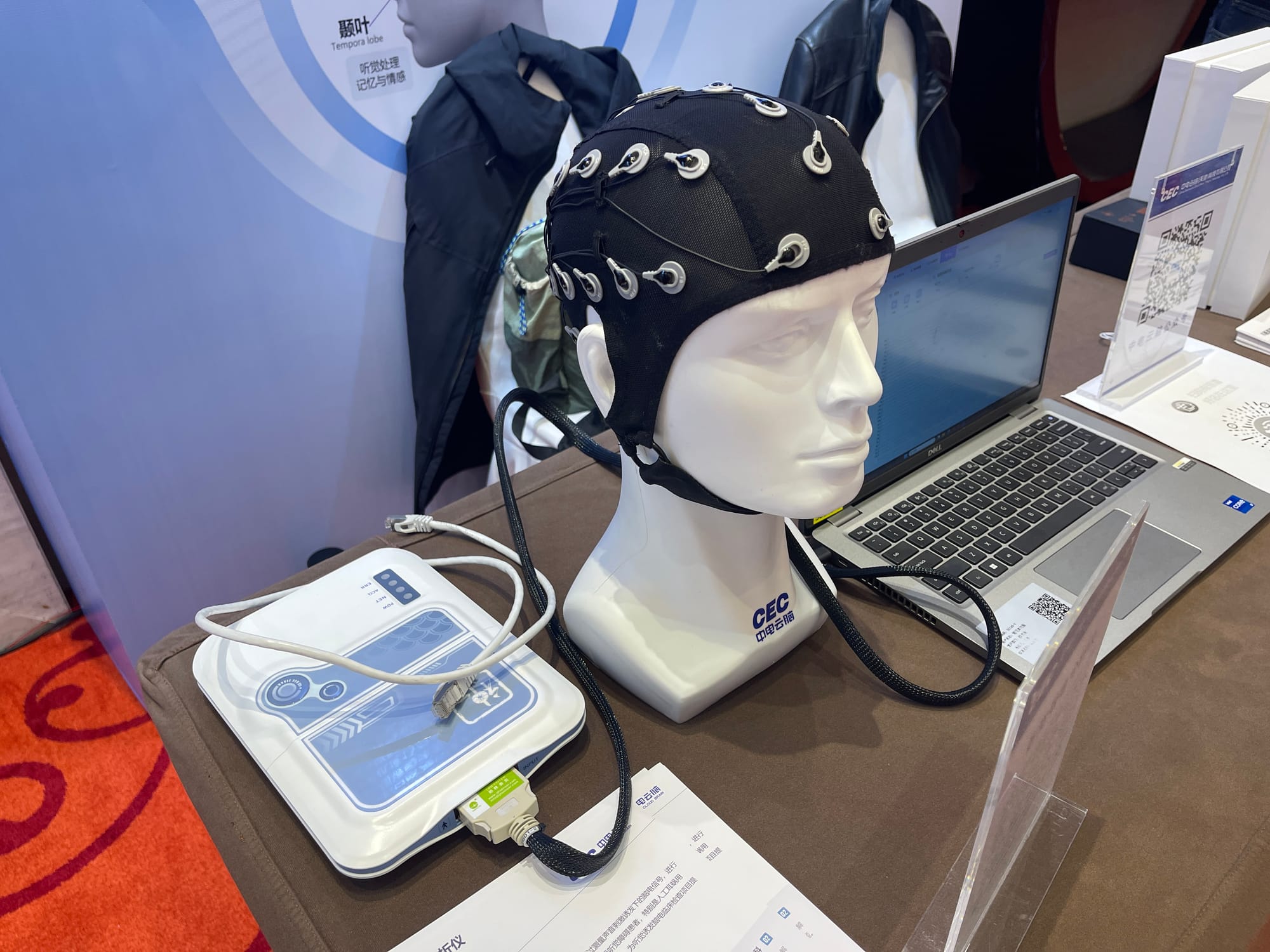
CECBrain is China Electronics Corporation’s core vehicle for BCI, tightly coupled with the Tianjin University neural engineering team. It launched the domestically proprietary “Nao Yu Zhe” EEG-specific chip series in 2019 and built an end-to-end stack from chip to hardware to platform to application — one of the few fully indigenous EEG front-end product lines in China.
The three chips released at the conference — high-precision EEG acquisition, encode/decode computing, and low-power wireless transmission — have all taped out and passed third-party verification, closing the “acquire–compute–transmit” loop domestically. They ship alongside 8-channel BCI headbands, sleep headbands, and other wearable form factors for research, clinical, and consumer use.
Indigenous front-end devices pull BCI hardware back from import dependence to domestic control. If the three chips reach volume and land inside consumer wearables, the cost curve should drop meaningfully — but whether that happens depends on downstream product sell-through, not on the chip milestone alone. Line utilization is the constraint, not the tape-out.
- Implantable Brain-Computer Interface Neurostimulator
PINS is China’s incumbent in implantable neuromodulation. It secured the first domestic DBS registration certificate in 2013, won the National Science and Technology Progress Award (First Class) for DBS key technologies in 2018, and co-built the National Engineering Research Center for Neuromodulation with Tsinghua University and Tiantan Hospital. Its portfolio covers DBS, VNS, SNM, and SCS.
The newly released implantable bidirectional closed-loop adaptive neurostimulator records and decodes deep-brain signals while stimulating, recognizes Parkinsonian pathological signatures, and adapts output on demand. It supports directional stimulation, 1.5T/3.0T MRI compatibility, and remote programming, with adaptive motor-loop and sleep-loop modes. It entered the National Innovative Medical Device Special Review procedure in September 2026.
Putting “read” and “write” into one implant is the necessary path from open-loop to closed-loop neuromodulation. Parkinson’s is the entry indication; sleep-loop and adaptive epilepsy will be the next ones only if the clinical endpoints hold up. The special-review channel is open, but the evidence chain from “works” to “better than existing DBS” still needs time.
- Wireless Implantable Ultra-Flexible Brain-Computer Interface System
StairMed focuses on minimally invasive implantable BCI. Its moat is a sub-micron flexible microelectrode — 1 micrometer thick, roughly 1/300 the cross-section of a human hair — backed by Alibaba, Tencent, Qiming, and Lilly Asia Ventures, with cumulative financing above RMB 1 billion.
Its wireless implantable ultra-flexible BCI system is recognized as the smallest-volume, least-traumatic fully intracortical BCI to date. It has completed 42 long-term implants, with cumulative in-body time above 5,000 days and brain-control usage above 10,000 hours, restoring motor function for tetraplegic participants.
The 1-micron flexible thread theoretically suppresses the gliosis problem that plagues rigid arrays. The open questions are channel scaling and registration-clinical closure — whether it moves from research unit to deliverable product depends on endpoint completeness and process maturity, not on the electrode spec alone. It is the domestic reference point against Neuralink, but a reference point, not a parity claim.
- ND Series Multimodal Signal Acquisition System
NeuroDance grew out of the Tsinghua Neuroengineering Lab, with Prof. Gao Xiaorong as chief scientist. It is among the first cohort of MIIT “Future Industry 揭榜挂帅” BCI winners, positioned around a “NeuroAI group cross-modal data platform,” fully indigenous, balancing remote transmission, portability, and acquisition precision.
The ND series synchronizes 14 physiological signals plus motion data; the ND8S-VR embodied neural–action capture kit targets embodied-AI training directly and is one of the few domestic platforms covering both research-grade precision and engineering delivery.
Multimodal sync lands exactly where embodied AI is starving for human-source data. If the VR kit closes a robot-training loop, payback could arrive faster than in medical rehab — but NeuroDance’s edge is annotation quality, and annotation standards are not yet industry-fixed. Latecomers still have room.
- Hetu 256-Channel Wireless High-Density EEG Acquisition System
Nianji focuses on wireless high-density EEG (HD-EEG), with a line spanning LinkMe wearables, Fubai sensing devices, and the Hetu professional acquisition system. Deployments cover industrial safety, rehab, neuroscience, and education; it took a CES Asia 2026 Best Innovation award.
Hetu cracks the 256-channel weak-signal wireless portability bottleneck, reaching international-advanced core specs on an indigenous platform. Traditional research HD-EEG is imported and cabled; Hetu makes it wireless and portable.
Wireless is a necessary but not sufficient condition for replacing imported HD-EEG. Research-side swap-over hinges on price-to-service ratio; clinical expansion into epilepsy pre-surgical mapping still needs a registration certificate. The timeline and the uncertainty are both real.
- BCI Mindfulness-Feedback Motion-Sickness / Sea-Sickness Prevention Product
iHNNK is a certified high-tech enterprise and SME “specialized and new,” with unusually strong export traction.
The product pairs single-channel EEG with an app-based neurofeedback loop. Tested on more than 300 people with an efficacy rate above 85%, it has shipped to more than 110 countries — positioned as the first non-pharmacological, side-effect-free anti-motion-sickness BCI product, extending into stress relief and sleep.
This is the most consumer-shaped item on the list. Export volume proves non-medical BCI can repeat-sell, but the real constraints are app retention, overseas channel cost, and whether a single channel can be upgraded to multi-channel without triggering a clinical-evidence requirement.
- BCI Hand Exoskeleton Intelligent Diagnosis and Therapy Platform
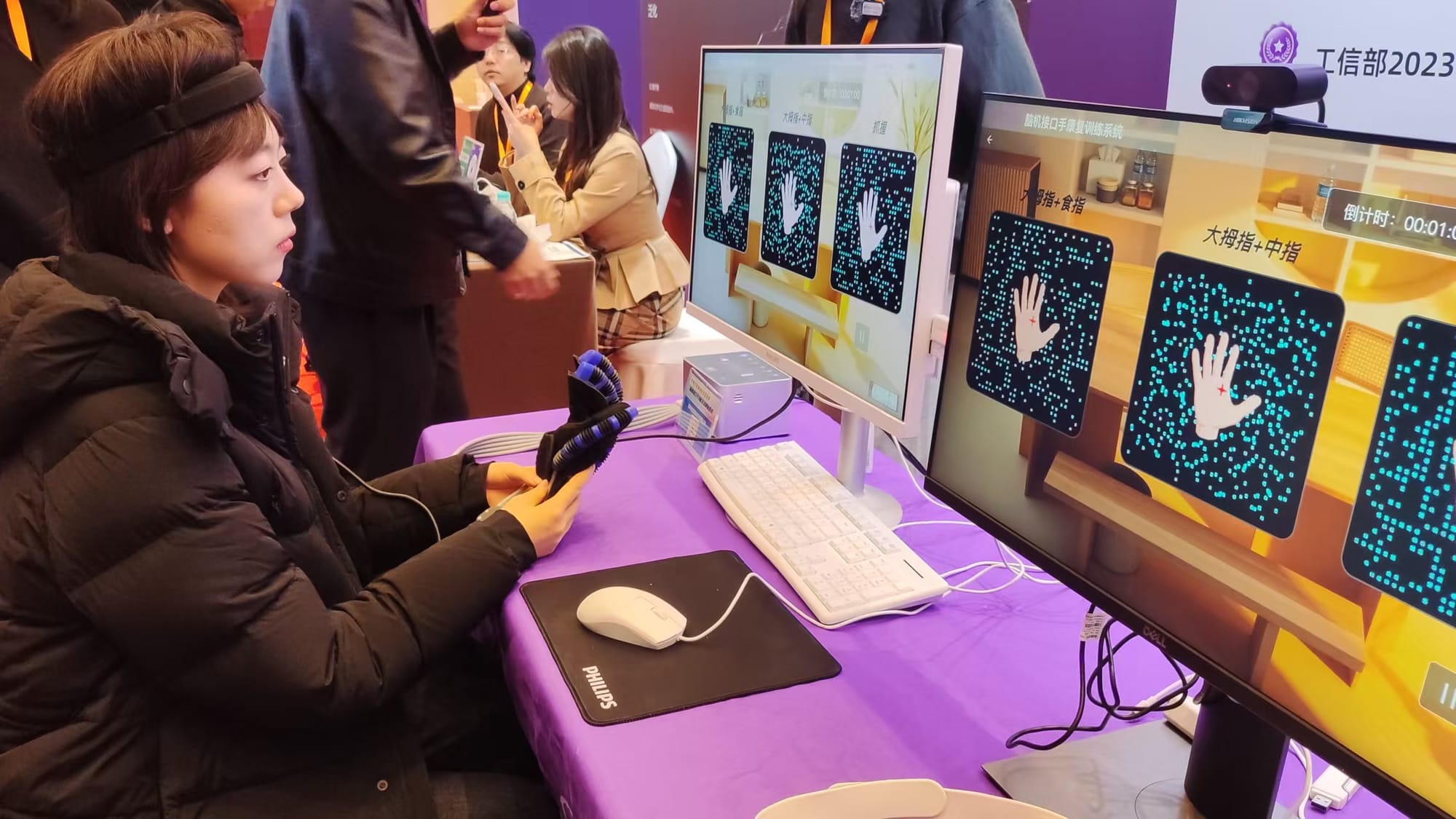
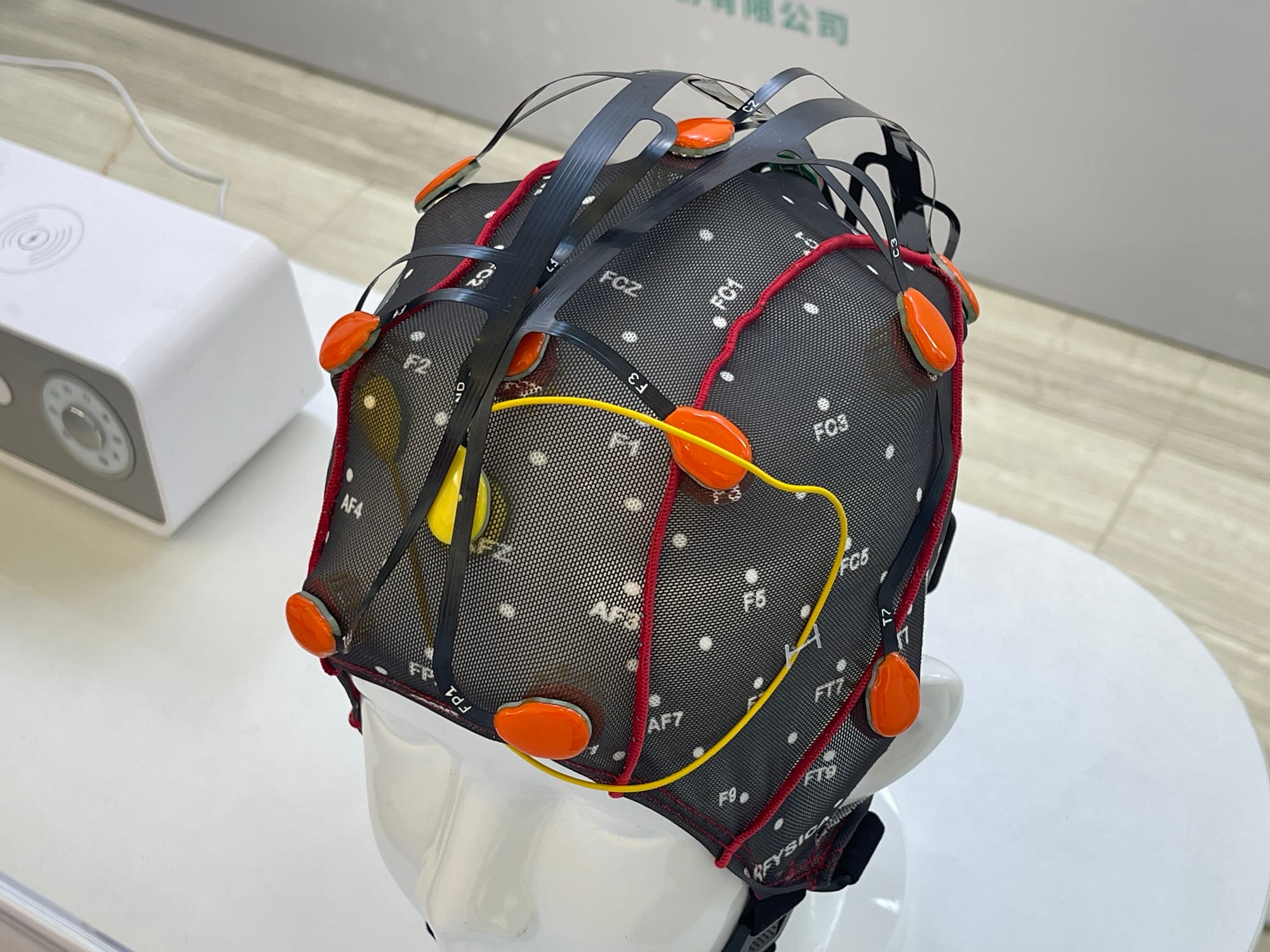
Arfysica takes the non-invasive route across four domains — limb motor, consciousness/cognition, neurodevelopment, and psychiatric disorders. It started STAR Market IPO tutoring in September 2026, with B+ and C rounds each in the hundreds of millions of RMB.
The platform couples BCI decoding with pneumatic/motor-driven exoskeletons for post-stroke, post-TBI, and post-tumor-resection rehab. It has served several thousand patients nationwide; the “assess–train–feedback” loop is in use at tertiary hospitals including Changhai, with medical-insurance listing in progress.
A closed loop inside tertiary hospitals means clinical validity is no longer the question; reimbursement is. Insurance listing is the volume switch, not a formality — if it slips, the addressable market collapses to self-pay rehab. IPO tutoring and the insurance negotiation window overlap in 2027; that is the fork.
- Real-Time Emotion Detection and Regulation System Based on BCI
CBrain is a member of the MIIT BCI Industry Alliance and a contractor under the “China Brain Project 2035,” working with UESTC and Sichuan University.
Released jointly with UESTC, the system targets personalized, intelligent diagnosis for psychiatric conditions. It has landed in more than 30 medical and rehab institutions nationwide, serving more than 10,000 person-times, upgrading subjective scale-based assessment into objective EEG-quantified detection with real-time feedback regulation.
Moving depression/anxiety from scale scores to EEG biomarkers is now sample-rich enough to train on. The bottleneck is clinical consensus, not algorithm — whoever gets into the psychiatry guideline first takes the category. After that: specialty-hospital screening workflow, then an insurance billing code.
- Naoyunti Cognitive and Emotion Assessment / Intervention Portable BCI System
CUSOFT is a founding member of the BCI Industry Alliance and a Zhongguancun BCI flagship. It has shipped eight product series, 5,000+ SKUs, into more than 5,000 schools and hospitals.
Naoyunti handles cognitive and emotional assessment and intervention for youth cognitive profiling, anxiety and depression identification at population scale, deployable in schools and clinics. It sits on a million-scale EEG norm database — one of the earliest domestic products to take EEG biofeedback to youth mental health at scale.
The million-subject norm base is the moat; school-plus-clinic beats pure medical on payback. But a policy tailwind is not a procurement order — education-bureau listing depends on local budget and compliance certification. Extending the norm base beyond adolescents is also bounded by baseline drift across age groups.
- BCI Smart-Helmet-Based Real-Time Power-Safety Monitoring and Warning System
State Grid SH is the State Grid provincial subsidiary responsible for Shanghai transmission–distribution O&M and production safety. It has recently pulled BCI into strong-EM-field operations for pre-emptive safety control.
Built on a BCI-interactive helmet, the system solves strong-EM EEG anti-interference and fatigue-recognition algorithms, warning before fatigue becomes observable. Pilot runs on transmission O&M show the helmet firing an alert ahead of visible fatigue onset.
Collecting microvolt EEG under strong EM is counter-intuitive on paper; the State Grid pilot says the physics closes. Helmet form factor means zero retraining. Scaling from Shanghai to other provincial grids is a procurement decision, not a research one — plus false-alarm rate and integration with existing safety stacks.
- BCI Active-Safety Intelligent Prevention and Control System
Deayea focuses on public-safety risk consulting and wearable risk-control hardware/software; certified high-tech enterprise.
The system fuses BCI, BeiDou positioning, and video analytics to identify driver fatigue from a wearable, building a human–vehicle–road safety loop. Graded-warning accuracy exceeds 90%; in heavy-truck pilots it pushed both incident rate and claims ratio down, and it is feeding the fatigue-driving determination standard.
Three-modal fusion is now accurate enough to sit inside a standard. Heavy fleets are the first payer; insurance pricing linkage is the real lever — more valuable than the sensor. But accuracy decay over larger samples and rougher roads is undisclosed, and a standard only bites if the regulator adopts it wholesale.
- Precise Brain-Circuit Stimulation System
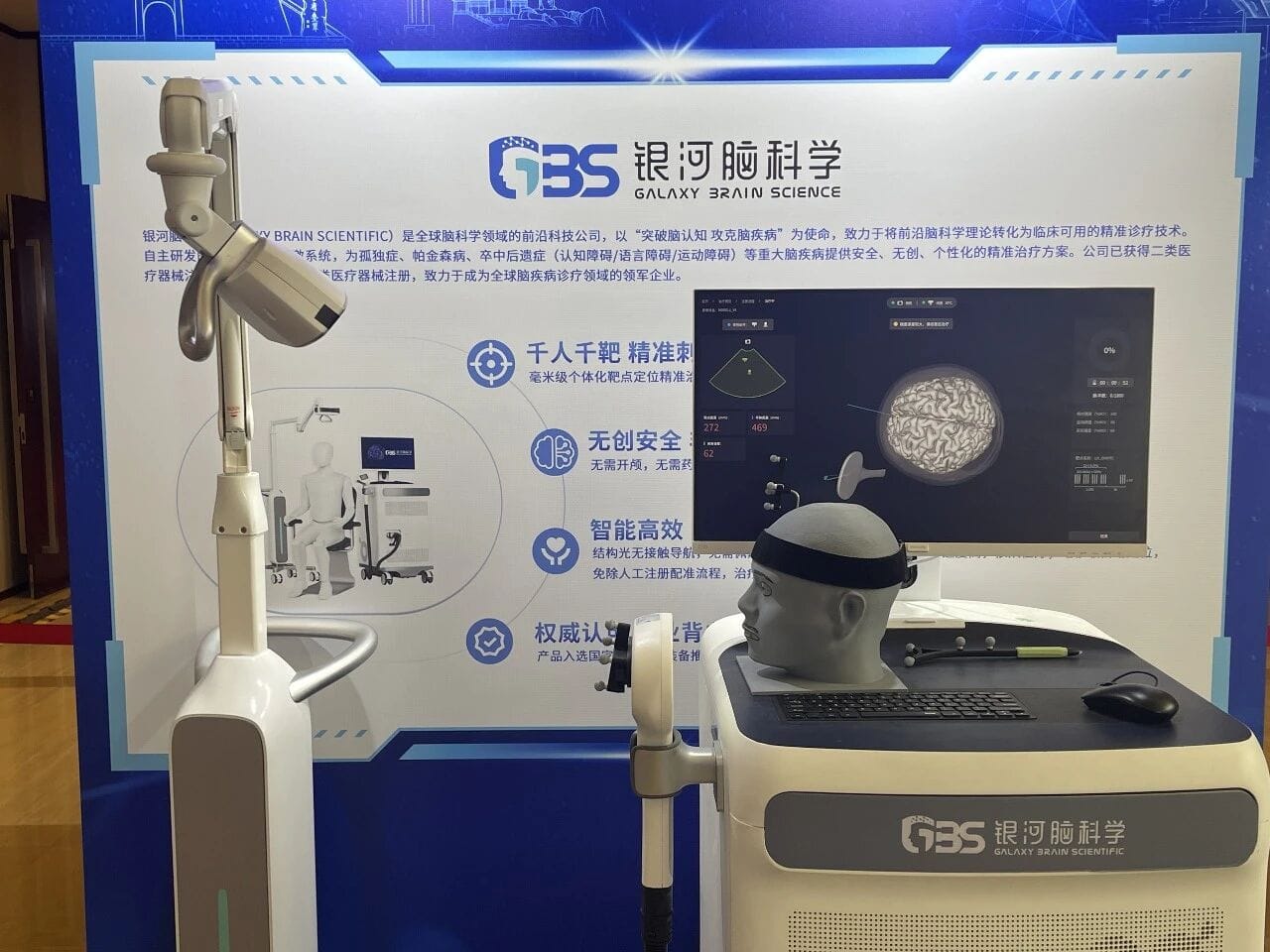
Galaxy Brain Science leads with the world-first pBFS (personalized brain function segmentation) — partitioning the brain into 213 functional zones for “one target per person” non-invasive modulation.
The pipeline reads fMRI → solves the pBFS map → writes transcranial magnetic stimulation, achieving sub-millimeter (≤1 mm) non-invasive modulation. It holds three Class II medical device registration certificates and is listed in the national high-end medical equipment promotion program, targeting post-stroke, autism, and Parkinson’s motor/cognitive/language recovery.
pBFS turns “one target per person” into an imaging closed loop; three Class II certs plus the promotion catalog make it the most commercially advanced non-invasive entry on this list. Class II scope is narrow, though — autism and post-stroke cognition need Class III, and the pBFS map only becomes a field standard if other centers reproduce it.
- Brain–Computer Hybrid Intelligence for Squad Multi-Modal Sensing and Cooperative Control
Zhentec works long-term with Xi’an Jiaotong University on BCI rehab and multi-modal interaction; B-round done, products span hand-function rehab, cognitive rehab, and wearable physiological monitoring.
This result pushes BCI from single-operator control to human–unmanned squad cooperation: synchronized EEG units, brain-controlled robot dogs, and guidance helmets enabling multi-person non-invasive EEG capture, asynchronous BCI interaction, AI–brain cooperative target recognition, and 3D cooperative guidance — aimed at military, emergency rescue, and industrial inspection.
Going from one brain to a squad raises system complexity by an order of magnitude. Military/patrol/rescue buy reliability first; civilian rollout waits for robot-dog unit price to halve. The hard part is asynchronous decoding stability under multi-person interference — public data do not yet let us score robustness in real missions.
- Neuron-Level High-Throughput Wireless Implantable BCI System
BCIflex built a ~2,000 m² clinical-grade micro/nano fab and GMP workshop in Changping, with in-house flexible electrode → hardware → decoding → implantation robot capability; 40+ patent applications filed.
The system is a wireless implantable BCI. In May 2026 it launched the LEAP prospective multicenter clinical trial at Beijing Tiantan Hospital across 11 institutions, first cohort 32 participants with high thoracic spinal cord injury and tetraplegia, and it has entered the National Innovative Medical Device Special Review (green channel).
Full-chain flexible-electrode self-development plus dual green channels plus multicenter start is the most resourced domestic invasive entry. If Tiantan’s cohort reads out in 2027, it resets the domestic invasive ceiling — but in-body lifetime and wireless bandwidth stability are the two numbers that will decide it, not the green-channel status.
By composition, Beijing holds 6 of the 15. The implantable line (NeuCyber, StairMed, PINS, BCIflex) and the device layer (CECBrain, Nianji) mark where the technical ceiling is being pushed; the non-medical deployments (iHNNK, State Grid SH, Deayea, Zhentec) are probing consumer and industrial payment paths separately. The same conference also released industry figures — 1,175 companies worldwide, with China’s three major city clusters accounting for 77.4% of domestic activity — and landed the BCI talent platform and high-quality data platform in Changping. Those numbers describe concentration, not yield: company count is not effective capacity, and industrial maturity still has to be paid for in clinical conversion and commercial return.