Neuralink’s “Layer Zero” Patent Lands: No Electrodes, Just a Living Neuronal Layer

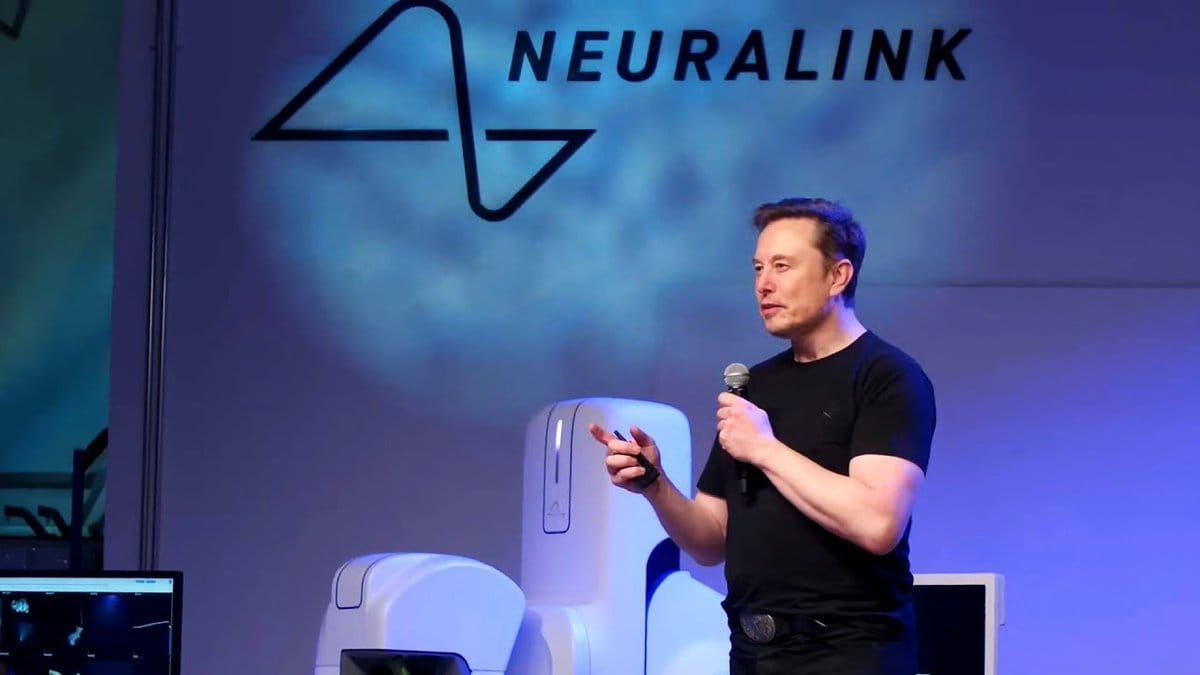
On November 17, the US Patent and Trademark Office granted Neuralink a cell-level brain-machine interface patent, US 12,797,514 B2, based on application US 2023/0077899 A1 (application No. 17/545,843, filed December 8, 2021). The invention is titled Cell-Based Brain-Machine Interface. Inventors include Max J. Hodak, Jean-Charles Neel, Emilienne M. Repak, Alan R. Mardinly, Madison D. Taylor, Alexandra Borog, Kevin S. Smith, Viktor Kharazia, Thomas K. Roseberry, Timothy J. Gardner, Sunny Y. Weber, and Amir Mazaheripour. The assignee is Neuralink Corp. The patent term is adjusted to expire around February 13, 2045.
The core idea is to form an artificial cortical layer, Layer Zero or L0, by engrafting genetically modified neuronal cells onto the surface of the adult mammalian cortex, above cortical layer 1. In the disclosed mouse preparation, primary cortical neurons were electroporated ex vivo with plasmids such as pCAG-GCaMP7s-P2A-H2B-mRuby3, then deposited onto the cortical surface. Instead of mechanically penetrating the brain parenchyma, the grafted cells extend dendrites and axons that non-destructively infiltrate the host cortex. Over several weeks, L0 activity shifts from broad synchronous waves to decorrelated, spontaneous-like cortical dynamics. Histology shows that L0 dendrites carry postsynaptic markers including SynGAP1, while axons align with presynaptic synaptophysin, forming excitatory chemical synapses with the host. L0 neurons also receive apparent GABAergic input marked by GAD65.
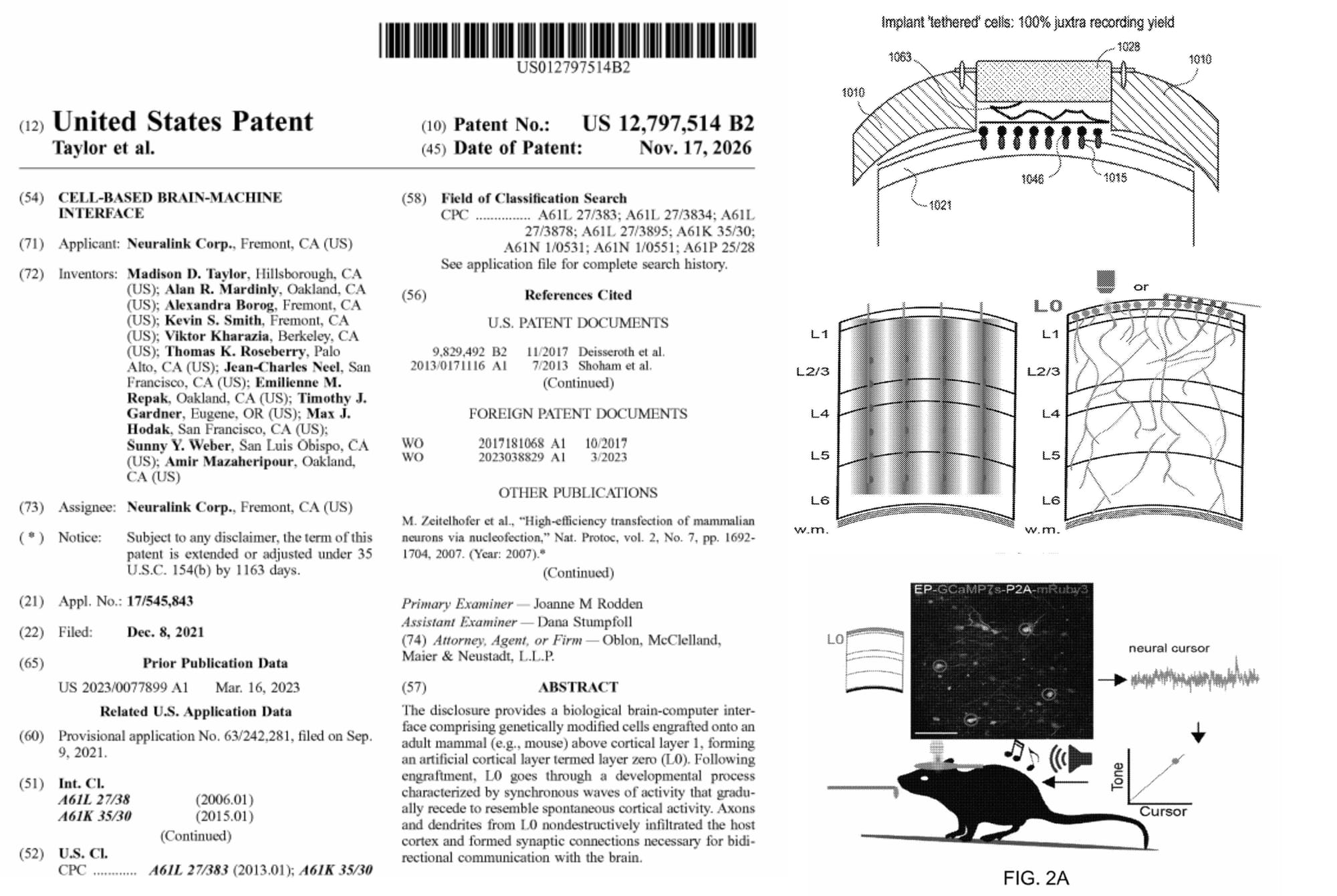
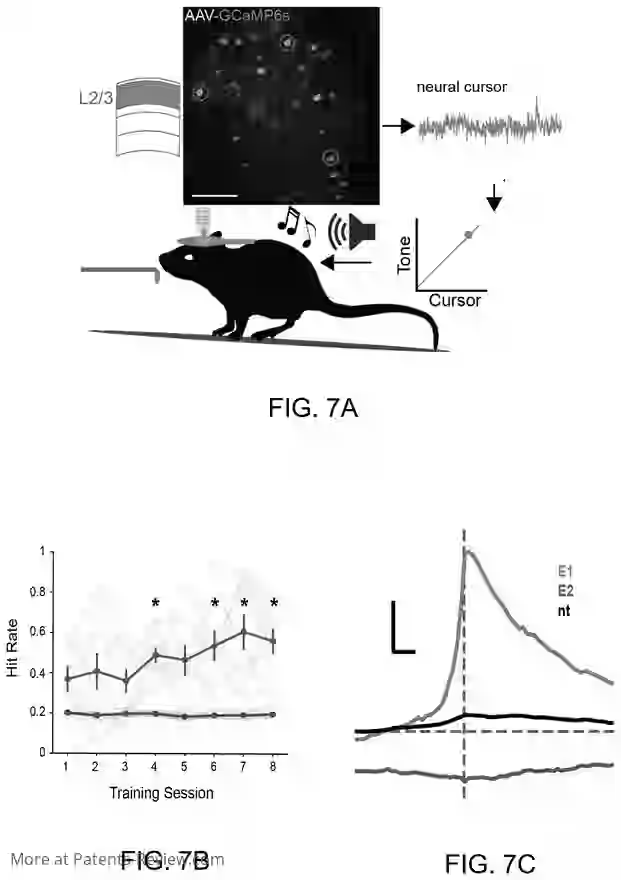
For readout, two-photon calcium imaging defined a neural cursor as the difference between the mean activity of a “go” ensemble, E1, and a “no-go” ensemble, E2. Engrafted mice beat chance by day three and could perform a contingency reversal, showing that the biological layer supports bidirectional communication: brain signals are projected to the surface, and surface activity is coupled back into the network through synapses.
The target is the old bottleneck of penetrating interfaces. Every penetration displaces tissue, damages microvasculature, and eventually triggers glial scarring, biofouling, and encapsulation failure. Flexible electrodes reduce the trauma but do not remove it. L0 uses living neurons as the interface: the material properties match the brain, the tissue tolerates micromotion, and the host genome is not modified by viral transduction because the cells are engineered ex vivo. The patent also describes electrical implementations, where engrafted cells are tethered to ECoG surface electrodes or embedded in a hydrogel package, so the signal can be recorded without optics. Writing back can use optogenetics or low-power electrical stimulation through chemical synapses, potentially at single-cell resolution.
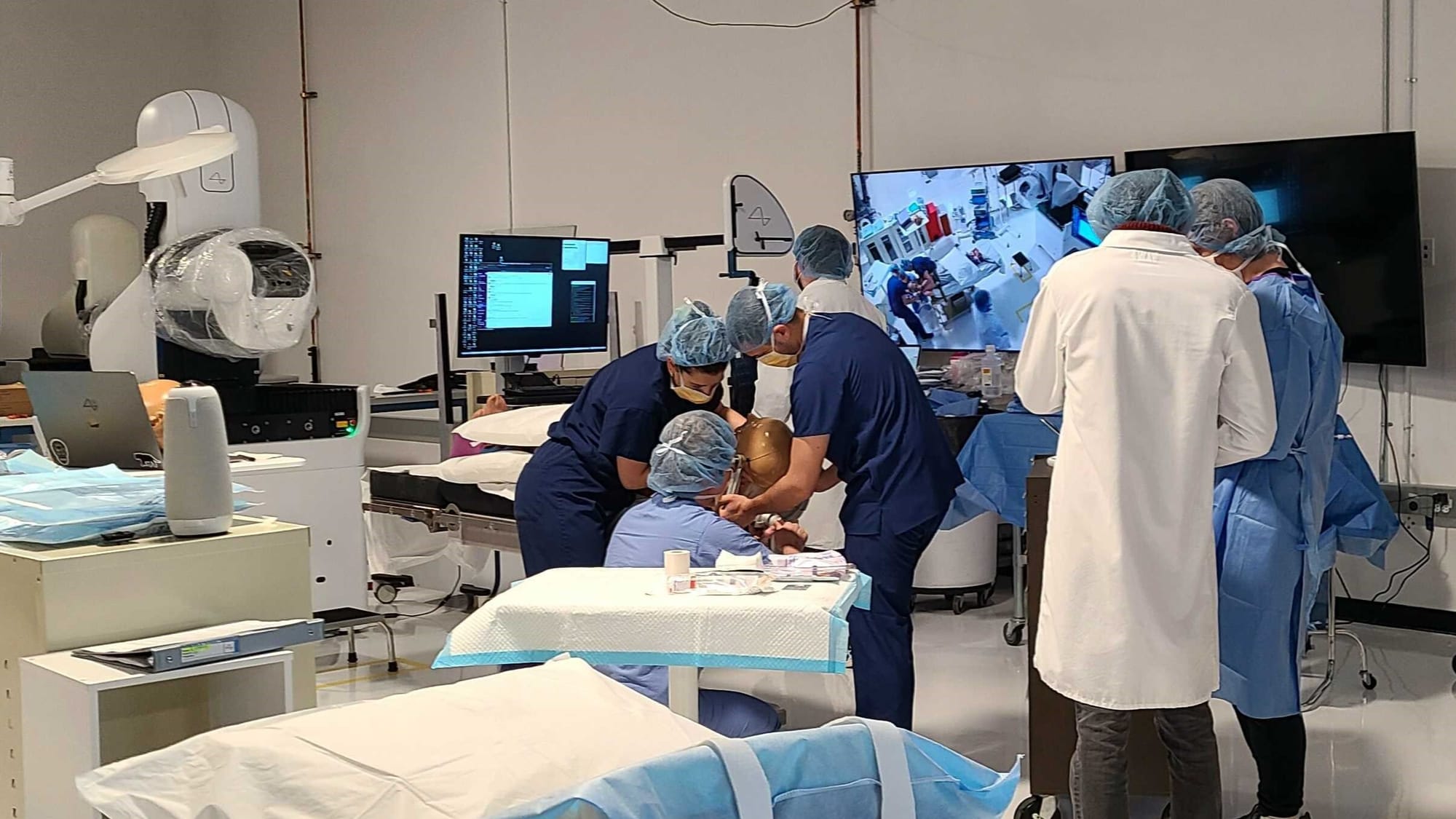
Read against Neuralink’s current pipeline, this is one hardware base, several clinical products, and one long-horizon reserve. The N1 implant and R1 surgical robot are the base: a fully implanted device with 1,024 electrodes distributed across 64 flexible threads, placed by R1 into motor cortex while avoiding vasculature. In May 2026, Toronto performed the first transdural implantation without opening the dura. On the algorithm side, more than 50,000 hours of unlabeled neural data support self-supervised pretraining; cursor information transfer has reached 11.32 bits per second, and for some users calibration has fallen from ten minutes a day to ten minutes a week. In the VOICE speech trial, an ALS participant decoded speech at 75 words per minute in the first week, with a 5.8% word error rate.
On top of N1 sit the clinical programs. Telepathy is thought-controlled cursor, phone, and computer use. CONVOY targets robotic arms and wheelchairs. VOICE restores speech. Blindsight, aimed at vision restoration, holds FDA Breakthrough Device designation. PRIME2 now extends enrollment to chronic ischemic stroke. All of them share the N1 hardware and differ in decoding target and indication.
L0 is the third line, still a reserve. It does not penetrate brain tissue; it grows a recordable, stimulable, customizable living intermediate layer on the cortical surface. So far it is validated only in mice. In the near term it complements N1: N1 enters the clinic now, L0 addresses long-term bandwidth, biocompatibility, and channel scaling. In the long term, it moves the interface from the electrode–tissue contact surface to the synaptic–network coupling surface, where the implant becomes part of the tissue.
A grant is not a therapy. L0 still has to clear immune rejection, graft survival, vascularization, and human-scale channel density. The roughly 27 N1 human implants tracked by November 2026 remain early feasibility data, not marketed performance. But the patent makes the direction clear: the next variable in high-bandwidth brain-machine interface may not sit in silicon. It may sit in cells.