Neuralink’s New Patent: Using Specialty Plastic to Solve the “Thousand-Wire Seal” Challenge in BCI

Neuralink has recently been granted a patent covering a new approach to packaging chips for brain-computer interfaces. The patent proposes replacing conventional glass or metal housings with a high-performance plastic, with the core objective of allowing hundreds or even more than a thousand ultra-fine electrode wires to exit the chip safely while maintaining long-term hermeticity of the enclosure.
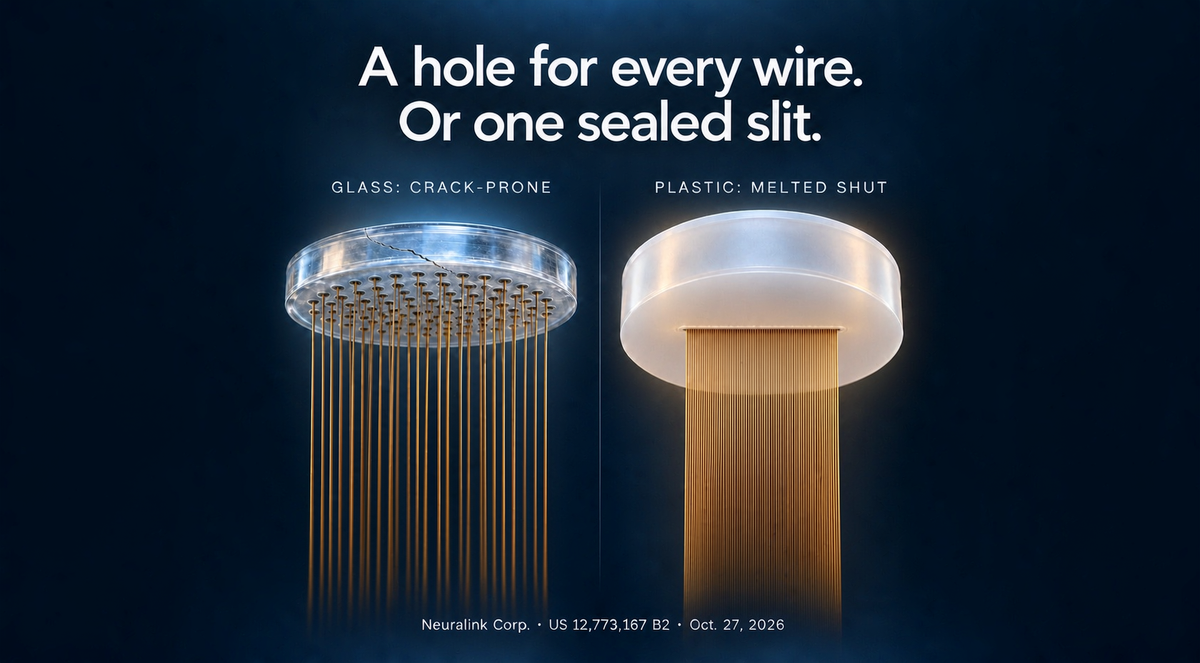
Brain-computer interfaces rely on large numbers of ultra-thin electrode wires that extend into the brain to capture neural signals. The greater the number of wires, the richer the information the system can obtain, and the stronger the foundation for future high-precision thought-based control. The difficulty lies in bringing these wires out of a sealed enclosure. Traditional glass or metal packages use a “one hole per wire” design. When the wire count reaches the hundreds or thousands and the spacing becomes extremely small, this approach readily leads to glass cracking or seal failure, making long-term reliability difficult to ensure.
The new patent’s solution is to fabricate the enclosure from a high-performance plastic known as PCTFE. Instead of drilling individual holes for each wire, a single slit is cut in the plastic. Multiple insulated wires are passed through the slit in parallel, after which the assembly is heated and pressurized so that the plastic melts. The molten plastic flows around and tightly encapsulates the insulation of each wire; upon cooling, it forms a continuous sealed structure. As a result, the wire bundle can exit perpendicularly from the bottom of the enclosure, while the housing itself is largely free of the dense array of individual perforations that characterize conventional designs.
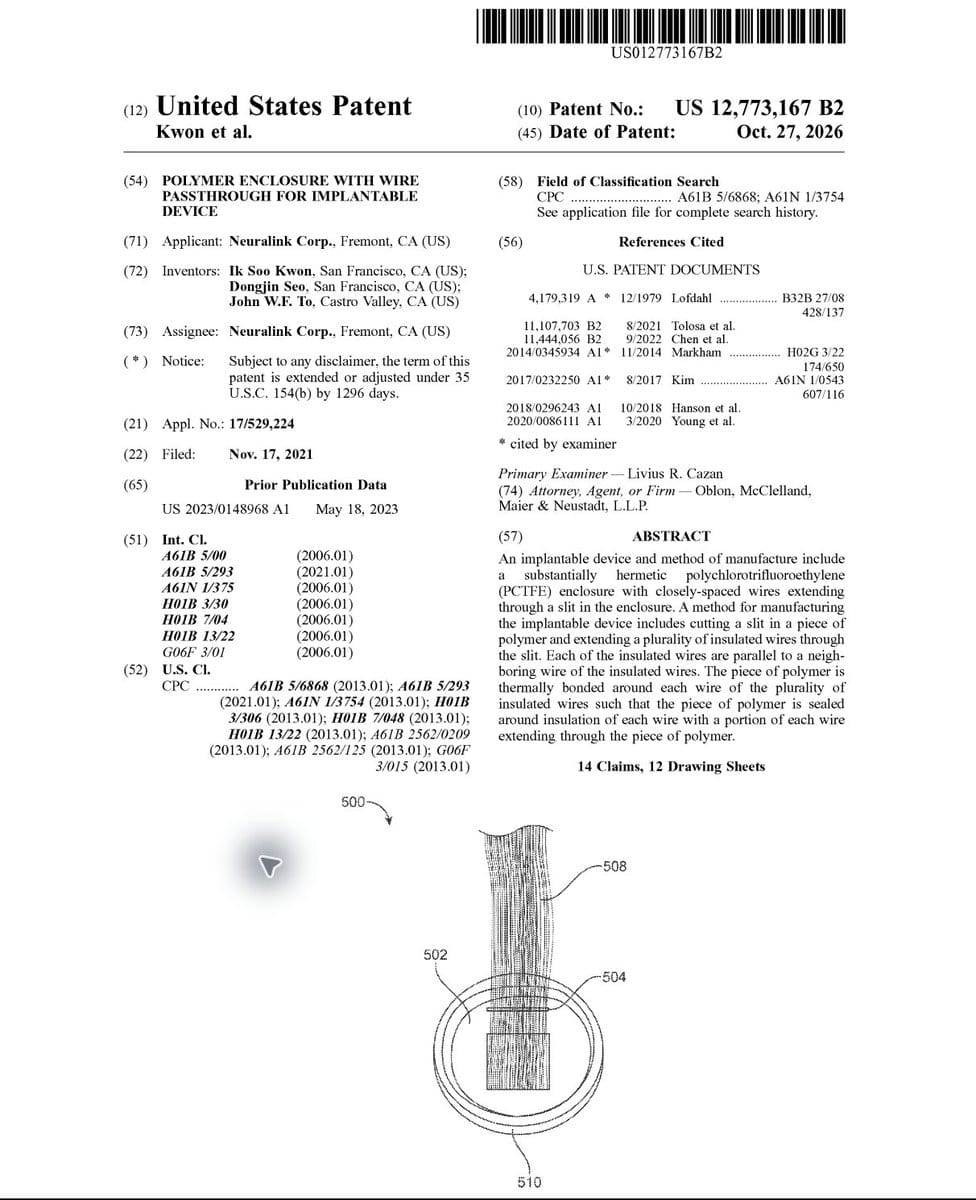
According to the patent documents, the method can accommodate at least several hundred and potentially more than one thousand wires simultaneously, with substantially reduced spacing between them. PCTFE exhibits extremely low water absorption and excellent barrier properties, which help prevent long-term ingress of bodily fluids. Because the enclosure is made of polymer, electromagnetic signals for wireless charging and Bluetooth can pass through without the need for additional windows. The perpendicular exit of the wires also helps reduce bending and mechanical stress.
For general readers, the value of the technology lies in addressing a concrete engineering bottleneck encountered when packaging high-density brain-computer interfaces. In the past, the tension between enclosure materials and wire density limited the number of channels that could be supported. The melt-sealable plastic approach now offers a path to significantly increase wire density while preserving seal integrity. Although this does not mean the technology is fully mature, it provides a clear technical route for improving device performance and long-term implant reliability.
It should be noted that the patent describes a manufacturable process concept. Actual use in the human body will still require rigorous validation of biocompatibility, long-term hermeticity, and overall safety. The patent was granted on October 27, 2026, and the related documents are available in public patent databases.
Overall, the patent offers a relatively straightforward response to the sealing challenge of high-density electrode egress and reflects Neuralink’s continued focus on solving specific, practical engineering obstacles.