Does Nanotech Stand a Chance in Brain-Computer Interfaces?


Brain-computer interfaces have been all the rage in recent years, fueled by companies like Neuralink, but most technical approaches share an awkward reality: either you open the skull to implant electrodes, or your signal is so weak it can only recognize simple commands. Subsense, a Silicon Valley company, is trying a third path — delivering nanoparticles into the brain via the nasal cavity, then pairing them with an external wearable headset to achieve a non-surgical, bidirectional BCI.
In September 2026, they brought on Ray Kurzweil as Product and Vision Advisor; in late October, they added John Donoghue, the BrainGate pioneer, to their Scientific Advisory team. These two moves put the topic of "nasal-spray nanoparticle BCI" back in the spotlight.
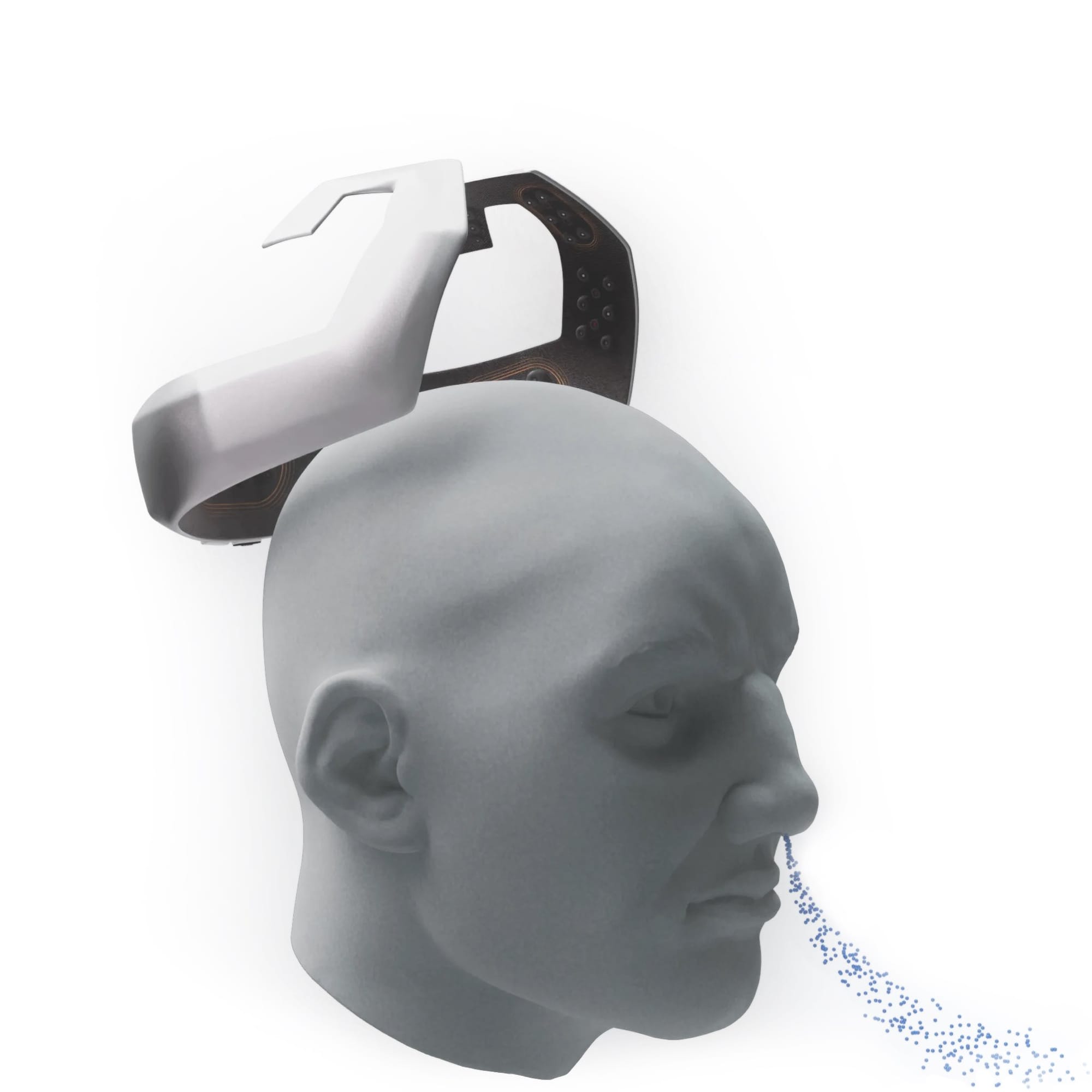
Subsense is headquartered in Palo Alto, California. Its co-founder and CEO is Tetiana Aleksandrova. The core idea: make the part of the interface that sits closest to neurons into nanoparticles, sized between tens and hundreds of nanometers, deliver them through the nasal cavity to cross the blood-brain barrier and reach brain tissue, while keeping the actual hardware outside as a headset.
There are two types of particles. The reading side uses plasmonic optical nanoparticles. The external headset emits near-infrared light; the particles alter their light-scattering properties based on local electric fields, and the device receives the back-scattered light to decode neural activity. Because light attenuates quickly in tissue, reading depth is currently capped at around three centimeters. The stimulation side uses magnetoelectric nanoparticles, driven by an external magnetic field to generate localized electrical effects and modulate neural activity. Magnetic fields penetrate far better than light, so stimulation can reach deeper brain regions than reading can. Compared to cranial electrode arrays or vascular stents, Subsense compresses invasiveness down to "a single nasal dose"; compared to traditional EEG, the sensors sit right next to the neurons. That said, the company repeatedly emphasizes that all work remains in the preclinical stage, with safety as the top priority, and mechanisms like magnetic-field-guided particle localization, magnetoelectric stimulation, and plasmonic reading are still under validation.
The design space for nanoparticles is absurdly vast. Core materials, shell structure, surface chemistry, response to light or magnetic fields, tendency to clump, and how long they stay in the brain — every single factor is a variable. The traditional approach has scientists pick a few candidates based on experience, synthesize them, test, and iterate, with each cycle taking months. Subsense inserted AI between "constraint definition" and "candidate shortlisting": scientists first define the physical and biological boundaries, then the model screens roughly 100 million quantum-mechanical reference configurations, ruling out risks like aggregation before anything enters the lab for synthesis. Aleksandrova calls this "AI-native BCI" — the criterion is straightforward: if you remove the model and the science stops working, it is native. The company has not yet released detailed validation data but stresses that AI has been involved since the materials discovery phase, not just for back-end signal processing.
The upgraded advisory roster makes this direction look less like a "brainstorm." Kurzweil joined in September 2026, focusing on the long-term convergence of biological and artificial intelligence and more natural human-machine interface architectures. On October 23, Subsense announced that Dr. John Donoghue had joined as Scientific Advisor. Donoghue is the founder of the BrainGate project and, in February 2026, co-received the Queen Elizabeth Prize for Engineering for pioneering the translation of motor cortex signals into control commands for external devices. His role leans toward technical pathways and evidence standards — guiding the team on how to prove nanoparticles can be precisely localized to target brain regions, achieve spatially specific stimulation, evaluate biological effects, and translate preclinical results toward human use. He recommends a stepwise approach: first demonstrate controllable, focused stimulation in intact animal models, then evaluate efficacy in disease models.
The company currently runs two parallel preclinical programs: one using magnetoelectric nanoparticles for brain stimulation targeting Parkinson's disease, the other focused on neural signal reading for ALS patients to help those who have lost the ability to speak communicate again. The long-term goal is to integrate reading and stimulation into one platform. The scientific advisory team also includes neuroscientist David Eagleman, who has discussed brain plasticity and the future possibility of near-"telepathic" direct human-to-AI communication.
Results at this stage remain preliminary. In mouse experiments, particles achieved both stimulation and signal recording, with biocompatibility studies showing no obvious adverse effects. Pig studies showed particles could move through the brain. Aleksandrova has made clear she will not claim validation until the full process holds, with the company aiming to demonstrate the complete platform in mice by the end of 2026. The seed round totals approximately $27 million. Between mice, large animals, and humans lie a series of hurdles: reproducibility, manufacturing, toxicology, biodistribution, clearance mechanisms, and regulatory approval.
There is potential, but it is early, and the pitfalls are many. Non-surgical, scalable, and AI-assisted materials design is genuinely unique in the BCI field. The asymmetry — shallow reading, deeper stimulation — means it may fit specific modulation scenarios rather than directly competing with implantable solutions across the board. Kurzweil paints the long-term vision; Donoghue brings the hard standard of "evidence must be solid" from classical BCI. This combination helps push the concept from "sounds cool" to "can it actually be built." The company also consistently emphasizes safety-first and preclinical status without overpromising.
But soberly speaking, the long-term distribution, clearance pathways, safety, and targeting precision of nanoparticles in the human body still require massive amounts of data. The three-centimeter light-reading limit constrains many application scenarios. The leap from animal results to humans is never linear. The "AI-native" claim is, for now, more of a methodological proposition that needs subsequent public data to back it up. At its core, Subsense is probing whether nanomaterials plus external hardware can find a truly practical middle ground between invasiveness and signal quality. Donoghue's involvement makes the scientific path clearer, but clinical translation remains distant. If the mouse full-platform data by year-end holds up and advances smoothly to large-animal studies, this direction is worth tracking; otherwise, it may stay at the level of an interesting proof of concept. Nanotech meeting brain-computer interfaces does have potential — it is just that this potential is still safely confined to the lab, with a long road ahead before it reaches the human body.