Neuralicorn: 71% Mandarin Decoding Accuracy, 1,024-Channel Chip on ISSCC

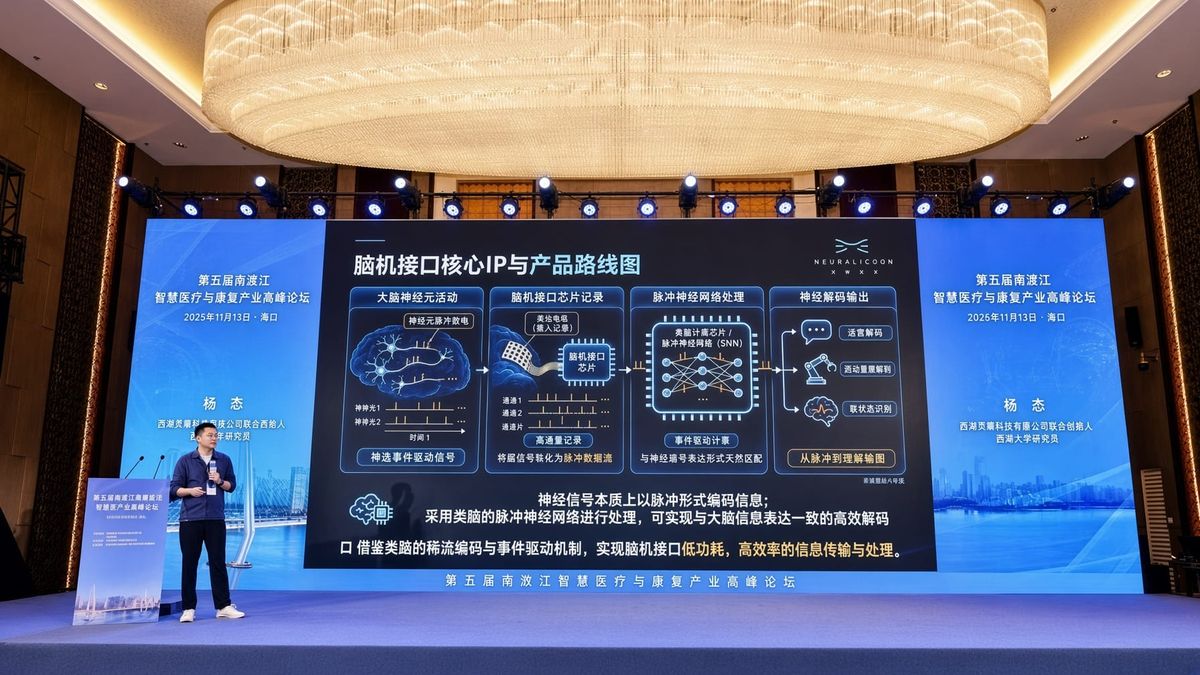
On November 13, at the 5th Nandu River Smart Healthcare and Rehabilitation Industry Summit, Dr. Jie Yang, Co-founder of Neuralicorn, systematically disclosed the company's latest progress in speech BCI.
Dr. Yang reviewed the evolution of human–computer interaction: from punched tape and command lines to graphical interfaces, touchscreens, and natural language dialogue. Mainstream interaction paradigms refresh roughly every 10 to 20 years, with BCI widely regarded as the next generation. Yet the current world record for invasive BCI information transfer rate is only 11.32 bits per second, and the technical roadmap has not converged—the industry is accelerating toward clinical medical-device applications. Based on this assessment, Neuralicorn adopted a "medical-first, interaction-next" path, using speech neuroprosthetics as the entry point. China has about 26.68 million existing stroke patients and roughly 4.23 million new cases each year; around 30% develop post-stroke aphasia, creating clear clinical demand for language restoration. The team believes speech neuroprosthetics serve patients today while accumulating data and technical foundations for next-generation interaction. Whether the endgame is medical or interactive, chips, data, and algorithms are indispensable infrastructure.
Chips are the first layer of the strategy. Neuralicorn anticipates the industry focus will migrate in stages: neural signal acquisition in the next 1–2 years, high-throughput data transmission in 3–4 years, and ASIC/SoC with on-chip decoding in 5–6 years. Following this rhythm, the company has deployed three product lines—neural signal acquisition, neural stimulation, and brain-inspired computing—covering invasive BCI, non-invasive BCI, and peripheral nerve stimulation. The self-developed 1,024-channel neural signal acquisition chip was published at ISSCC 2026, the first chip of its specifications from China presented at this flagship conference. In brain-inspired computing, the team has published in JSSC, CICC, and TBioCAS since 2021; a brain-inspired chip for speech decoding was built this year, with results to be disclosed soon. Three mass-produced chips—for signal acquisition, neuromodulation, and peripheral nerve stimulation—are planned for 2027.
Data and algorithms are the other two layers. Neuralicorn, with Westlake University, built an invasive Chinese-language database: about 20 subjects, 50 hours of stereoelectroencephalography (sEEG) data, covering ~14,000 characters and 4,200 sentences, annotated with pinyin, tones, and phonemes. The database will be fully open-sourced in 2027. On the algorithm side, the team proposed a Mandarin decoding framework based on initials, finals, and tones. In clinical tests at the affiliated hospital of Westlake University, the system achieves real-time whole-sentence decoding: top-1 hit rate >70%, top-3 hit rate >92%, latency <20 ms, and median character-level accuracy 71%.
Three 2027 milestones are set: chip mass production, data open-sourcing, and free dialogue beyond fixed sentence banks. From helping aphasia patients speak again to building infrastructure for next-generation human–computer interaction, speech BCI is moving from lab signals to shippable systems.